
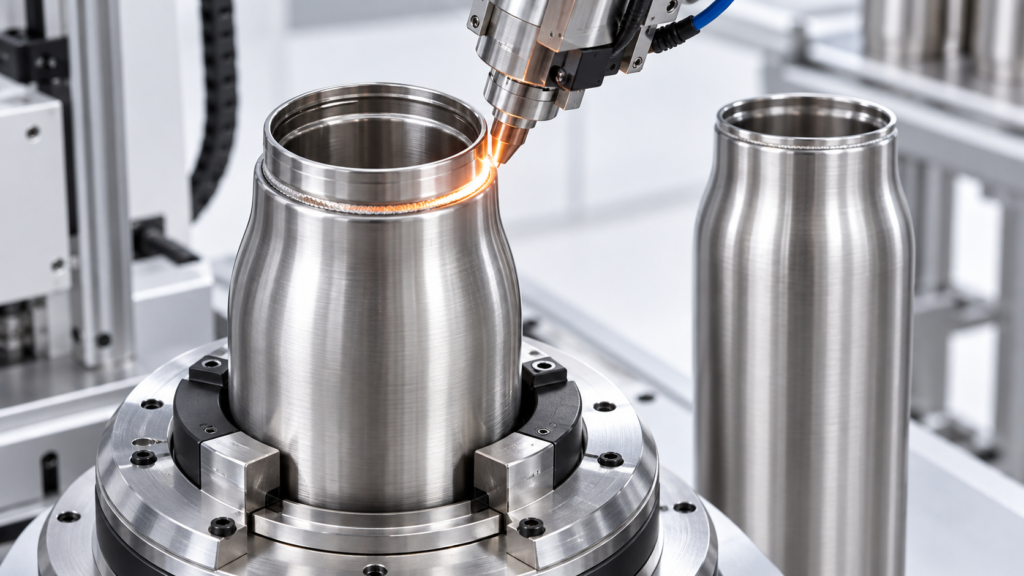
After the inner liner and outer shell of stainless‑steel drinkware have completed deep drawing, necking, trimming and mouth shaping, welding is required to assemble them into a rigid double‑wall structure.
Welding quality directly impacts structural strength, joint tightness, vacuum‑layer stability, as well as the results of subsequent polishing and surface finishing. Defects such as porosity, incomplete penetration or local deformation on weld seams may cause air leakage, water seepage, and even prevent the formation of an effective vacuum insulating layer.
Pre‑Welding Preparation
Before formal welding, dimension matching and fitting conditions of inner liner and outer shell must be verified. Key inspection items include:
- Height and caliber of inner liner and outer shell
- Roundness and concentricity of the bottle mouth
- Flatness of welding joints
- Compliance of assembly clearance
- Absence of oil stains, dust and metal chips on welding zones
- No deformation or scratches on cup bodies
Welding contact surfaces must stay thoroughly clean. Residual oil, oxide layers or contaminants will interfere with weld formation and raise risks of porosity and poor welding joints.
Bottle‑Mouth Welding: Joining Inner Liner and Outer Shell
For most double‑wall vacuum bottles, the inner liner and outer shell are connected at the bottle mouth. Positioning tooling holds workpieces concentric before welding to precisely control joint position and gap. Equipment performs continuous circumferential welding along the bottle mouth to firmly integrate inner and outer components.
Critical parameters for bottle‑mouth welding:
- Welding positioning
- Welding travel speed
- Laser / arc energy input
- Rotation speed of cup body
- Joint assembly gap
- Weld‑seam continuity
Excessive energy input may lead to mouth deformation or local burn‑through. Insufficient energy will result in incomplete penetration and insufficient joint strength. Equipment parameters shall be adjusted according to material thickness, bottle‑mouth structure and product dimensions.
Welding for Bottle Bottom & Other Structures
Subject to product designs, welding is also required for bottle bottoms, vacuum tail stubs and other connection points. Bottom welding affects not only visual appearance but also placement stability and sealing performance of vacuum interlayer. Components shall be firmly fixed during processing to avoid offset, warping and obvious welding marks. Welding sequences vary depending on structural design, material thickness and mass‑production requirements.
Common Welding Methods
Laser welding and TIG argon‑arc welding are widely adopted for thin‑gauge stainless‑steel drinkware manufacturing.
- Laser welding: Features narrow heat‑affected zone, delivers fine neat welds for high‑precision & appearance‑critical positions.
- TIG argon‑arc welding: Applied for special‑structure connections for certain custom designs.
Process selection comprehensively evaluates welding positions, material thickness, joint configuration, appearance requirements, production efficiency and workload for follow‑up grinding & polishing. Different bottle models do not adopt identical equipment solutions.
Post‑Welding Treatment & Weld Inspection
After welding, welding zones shall be cleaned. Partial welds need grinding for smooth surfaces, preparing for subsequent polishing, electrolysis and other surface treatments.
Visual inspection checklist:
- Continuity and uniformity of weld seams
- Defects including porosity, cracks and incomplete penetration
- Burn‑through and weld bead burrs
- Bottle‑mouth deformation status
- Concentricity between inner liner and outer shell
- Oxidation or contamination on welding areas
- Overall height and caliber of finished bodies
Visual check alone cannot detect all micro‑leak risks. Air‑tightness and leak tests are mandatory to verify sealing reliability of welded joints.
How Welding Determines Vacuum Insulation Performance
A sealed interlayer sits between inner liner and outer shell of double‑wall vacuum bottles. After vacuum pumping, sealing integrity of this interlayer is essential for heat‑transfer resistance. Tiny leak points on weld seams will let air seep gradually into interlayers, degrade vacuum degree, and ultimately weaken heat & cold retention performance. Welding is far more than simply bonding metal parts; it lays the fundamental foundation for the whole vacuum thermal‑insulation system.
Welding Consistency in Mass Production
During mass manufacturing, welding position, weld width and joint quality must remain stable. Factories regularly calibrate equipment parameters, inspect positioning tooling and welding‑gun conditions, while sampling products for dimension and sealing tests.
Process control helps minimize common failures: weld offset, partial missing weld, bottle‑mouth deformation, burn‑through & excess weld beads, inner‑outer shell misalignment, batch‑to‑batch process discrepancy, vacuum‑interlayer sealing failure.
Conclusion
Precision welding combines separately‑processed inner liners and outer shells into complete cup bodies. It serves as a prerequisite for vacuum pumping, surface finishing and final assembly.
Yongkang Hongrong Industry & Trade Co., Ltd. under brand Vflasche provides sampling, OEM & ODM manufacturing, full‑range quality inspection, packaging and shipment coordination services, tailored to your bottle shapes, capacities and structural custom requirements.
If you are developing custom vacuum bottles, sports water bottles, tumblers or other double‑wall stainless‑steel drinkware, please share product specifications, estimated order volumes and accessory requirements. We will evaluate suitable manufacturing solutions for your project.