
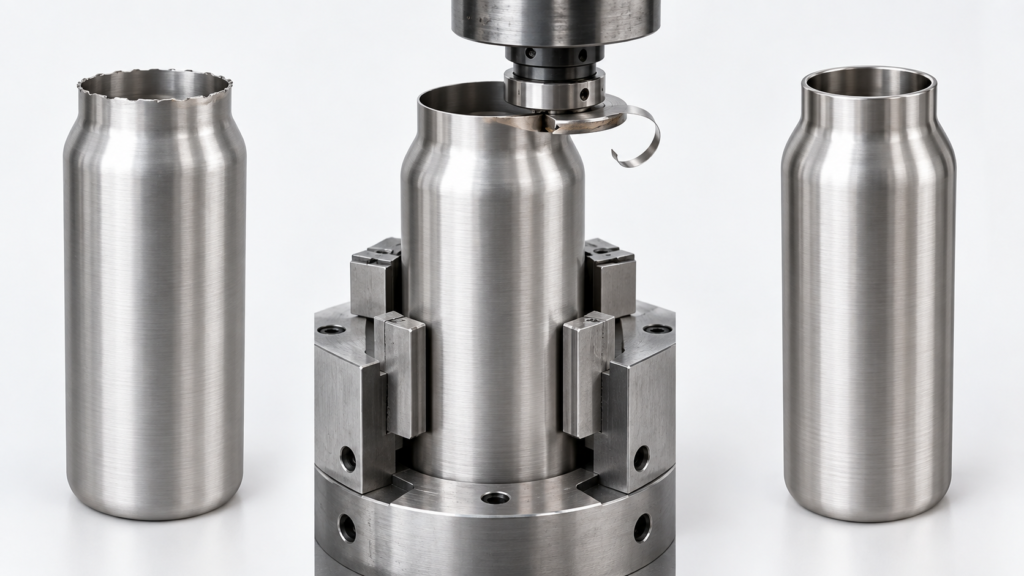
After deep drawing and necking, a stainless steel shell has its basic shape, but the upper edge may still contain excess material, slight height variation, burrs or uneven areas. Before welding, lid fitting and final assembly, the shell must go through trimming, deburring and mouth forming.
These may seem like small finishing steps, but they have a direct effect on dimensional accuracy, sealing performance, product safety and appearance.
Why Is Trimming Necessary?
During drawing and forming, stainless steel stretches and flows under pressure. As a result, the top edge of the shell may not be perfectly level and may contain excess material.
During trimming, the shell is held securely in a positioning fixture while a cutting tool removes the excess edge. This brings the shell to the specified height and creates an even rim for the next production stage.
Accurate trimming helps to:
- Control the overall shell height
- Produce a level and consistent rim
- Establish a reliable reference for mouth forming
- Reduce uneven or tilted openings
- Maintain consistency throughout a production batch
The trimming allowance must be adjusted according to the shell design, material thickness and required dimensions. Removing too little material can leave an uneven rim, while excessive trimming can affect the finished height and subsequent assembly.
Deburring and Edge Finishing
The freshly trimmed edge may be sharp or contain small metal burrs. It therefore needs to be deburred and finished before further forming or assembly.
Both the inner and outer edges of the opening are smoothed to remove sharp areas and minor cutting marks. This protects operators during later production stages and helps create a safer finished product.
The inspection normally checks whether:
- Any visible burrs remain
- The inner and outer edges are smooth
- The rim contains chips, dents or local deformation
- The opening remains round
- The shell surface has been scratched during processing
After edge finishing, the opening should be smooth, even and ready for mouth forming.
Mouth Forming Creates the Final Opening Profile
Once trimming and deburring are complete, the opening is formed according to the product design. Depending on the drinkware model, this may involve flaring, curling, pressing, rounding or sizing.
Mouth forming serves several purposes:
- Strengthening the edge of the opening
- Creating a smooth and uniform rim
- Controlling the opening diameter and roundness
- Providing the correct fit for lids, seals and accessories
- Preparing the shell for welding or further assembly
Not every drinkware product uses the same mouth structure. Insulated bottles may require an opening designed for a screw lid or sealing cap, while travel drinkware and mugs may use press-fit lids, sliding lids or straw lids. The opening therefore needs to match the intended lid system.
How Mouth Dimensions Affect Lid Fit and Sealing
The inside diameter, outside diameter, roundness, flatness and edge profile of the opening can all affect lid assembly.
An oversized opening may result in a loose lid. An undersized opening can make assembly difficult. Even minor deformation may prevent a sealing ring from sitting evenly, increasing the risk of leakage.
After forming, the following points may be checked:
- Inside and outside diameter
- Overall shell height
- Opening roundness
- Rim flatness
- Edge smoothness
- Compatibility with the lid and sealing ring
For some products, the actual lid is fitted during inspection to confirm opening, closing and sealing performance.
Maintaining Consistency in Mass Production
The process must produce more than one acceptable shell. It must maintain consistent dimensions across the complete production batch.
During production, shell height, opening diameter and rim condition are checked at regular intervals. Cutting tools, fixtures and forming dies are also monitored for wear or misalignment. If measurements begin to move outside the required range, the equipment and process settings need to be adjusted.
Stable tooling and regular inspections help reduce problems such as:
- Uneven rim height
- Out-of-round openings
- Remaining metal burrs
- Inconsistent lid fit
- Unstable sealing performance
- Dimensional variation between production batches
A Small Process with a Direct Effect on the Finished Product
Trimming and mouth forming connect the main shell-forming stages with later welding, polishing, finishing and assembly. A smooth, level and dimensionally accurate opening makes these downstream processes more reliable and helps the finished drinkware perform as intended.
Yongkang Hongrong Industry & Trade Co., Ltd., together with Vflasche, supports product sampling, OEM/ODM manufacturing, quality inspection, packaging and shipment coordination for custom drinkware projects.
If you are developing an insulated bottle, travel drinkware, water bottle or another custom drinkware product, send us your preferred design, capacity, quantity and accessory requirements. Hongrong can review the project and recommend a suitable production and customization plan.