
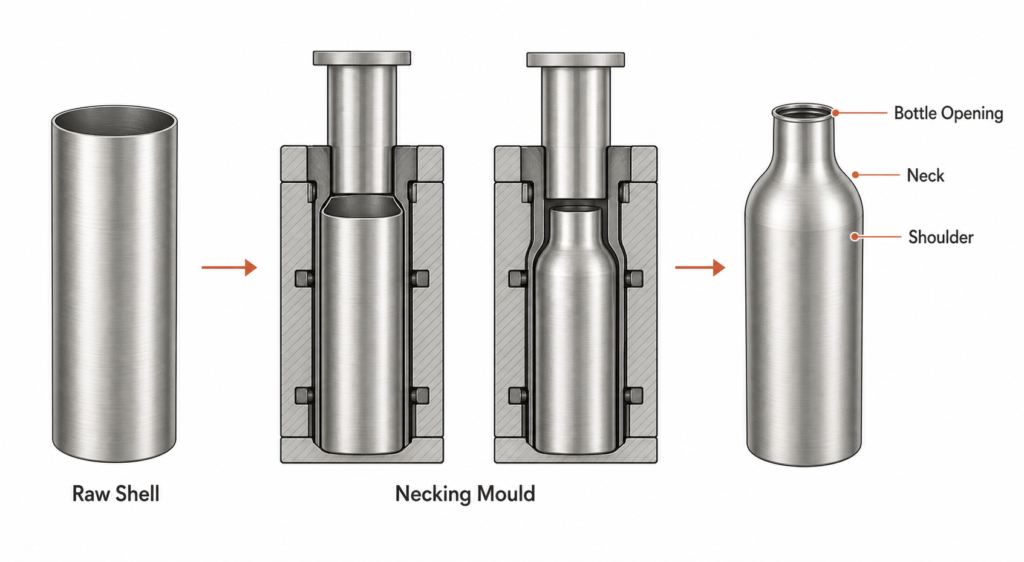
From Straight Shell to Precision Bottle Opening
After deep‑drawing, stainless‑steel shells come out as simple cylindrical blanks. For insulated water bottles, sport bottles and travel drinkware, the upper end of the shell needs to be reduced in diameter to form shoulders, necks and bottle openings. This manufacturing process is known as necking.
Necking defines not only visual appearance, but also cap fitting, thread forming, sealing performance and subsequent assembly. Deviations in necking dimensions may cause caps to fit too loose or too tight, misaligned openings, or even sealing failure and leakage.
What is Necking Forming?
Necking forming uses dedicated moulds and equipment to compress the upper section of the metal shell radially, tapering the wide straight cylinder down into a narrower neck and bottle opening.
This process is widely used to produce:
- Curved shoulders for insulated water bottles
- Narrow‑mouth structures for sport bottles
- Mounting zones for bottle caps
- Base dimensions required for thread machining
- Smooth diameter transition between body and opening
- Decorative shoulder contours for custom designs
Necking cannot finish in one single press. Where there is a large diameter difference between the original shell and final opening, multiple progressive forming passes are required to reduce the diameter step‑by‑step.
Six Core Steps of Necking Forming
Step 1: Shell Pre‑Inspection
Before necking, verify shell dimensions and surface condition. Key inspection items:
- Shell height and initial diameter
- Wall thickness and wall‑thickness consistency
- Roundness of the top opening
- Verticality of the shell body
- Surface scratches, dents and cracks
- Dimensional deviations from previous processes
Initial shell quality directly determines necking results. Uneven wall thickness, tilted body or out‑of‑round opening will trigger uneven stress, asymmetric shoulders or local wrinkling during necking.
Step 2: Shell Positioning & Mould Calibration
Load the shell into necking equipment and align precisely along the central axis. The shell, mould and machine must share the same centreline. Misalignment will result in offset neck and non‑concentric bottle opening.
Mould geometry is engineered according to target opening diameter, shoulder curve and product structure. Pre‑production sampling is essential to validate mould‑shell matching before mass production.
Step 3: Progressive Multi‑Pass Necking
Controlled pressure is applied by moulds to the upper shell, pushing metal inward gradually.
A single heavy‑reduction pass for large diameter change easily brings wrinkling, cracking or distortion. Therefore necking is split into multiple passes. Each mould only delivers moderate diameter reduction to guide stable metal flow, sequentially forming:
- Initial contraction zone
- Shoulder transition contour
- Neck structure
- Near‑net‑size bottle opening
Progressive processing lowers deformation per pass, optimises material flow and greatly reduces risks of cracking and wrinkling.
Step 4: Shoulder Contour Shaping
Necking is not only about narrowing the opening; it also builds the transition shoulder between bottle body and neck.
Common shoulder styles include circular‑arc transition, gentle sloped shoulder, short sharp‑recess shoulder, long curved shoulder and decorative custom profiles.
Shoulder design must balance aesthetics, material ductility and mass‑production stability. Too‑tight transition radii or over‑concentrated deformation may cause material piling or excessive local stretching. Complex shoulder shapes are also formed via successive mould passes.
Step 5: Bottle Opening Dimensional Calibration
After primary necking, fine‑tune dimensions of neck and bottle opening.
Critical controlled parameters:
- Outer & inner diameter of bottle opening
- Neck height
- Opening roundness
- Concentricity between opening and shell body
- Shoulder height and bilateral symmetry
These dimensions govern downstream operations: flanging, thread rolling, welding and cap assembly. Even minor dimensional drift can change cap‑twisting feel and seal‑ring compression. Strict dimensional inspection after necking is mandatory.
Step 6: Trimming & Preparation for Downstream Processes
Necking may leave uneven edges or height variation on the top. Trimming, levelling or secondary calibration will be carried out according to product requirements.
Post‑necking shells proceed to subsequent processes:
- Top trimming
- Flanging
- Thread forming
- Top welding
- Polishing & cleaning
- Cap and seal fitting test
Necking must deliver stable, precise opening dimensions to support all follow‑up manufacturing steps.
Key Control Factors for Necking
- Reduction ratio per pass: Excessive diameter reduction in one pass causes wrinkling, cracking or shoulder deformation.
- Mould profile: Smooth transition curves are required to avoid sharp corners and stress concentration.
- Material ductility: Wall thickness and material temper decide deformation capacity; process parameters shall match shell material.
- Shell positioning: Co‑axial alignment of shell, mould and machine prevents offset opening and asymmetric shoulders.
- Lubrication & mould condition: Proper lubrication reduces friction and scratches. Worn moulds, burrs or contaminants will leave indentations on workpieces.
Common Necking Defects
- Shoulder wrinkling: Material piling during inward contraction, usually caused by over‑reduction per pass, poor mould design or abnormal material flow.
- Bottle opening cracking: Deformation exceeds material limit, mostly appearing at opening or shoulder area.
- Offset / eccentric opening: Caused by mis‑positioning or inconsistent incoming shell dimensions.
- Asymmetric shoulder: Deviation from machine, mould or shell placement leads to uneven height and curve on two sides of shoulder.
- Surface scratches & indentations: Resulting from mould wear, foreign particles or insufficient lubrication.
- Unstable batch dimensions: Mould wear, material variance and parameter fluctuation lead to inconsistent neck diameter or height across batches.
Quality Inspection after Necking
Before transferring to next process, perform full inspection:
- Inner & outer diameter of bottle opening
- Neck height
- Opening roundness
- Concentricity between opening and body
- Shoulder contour and bilateral symmetry
- Surface scratches and indentations
- Wrinkles and cracks
- Wall‑thickness variation
- Conformance to technical drawings and approved samples
For selected products, perform fitting test with real caps and gauges to verify assembly and sealing performance.
Deep Drawing vs Hydroforming vs Necking
These three core processes serve different roles in stainless‑steel drinkware manufacturing:
- Deep drawing: Forms basic hollow cylindrical shells from flat stainless‑steel blanks.
- Hydroforming: Uses internal hydraulic pressure to create curved, waisted or outward‑expanded body profiles.
- Necking: Tapering the upper shell to manufacture shoulders, necks and bottle openings.
Actual workflow depends on product design. Straight‑body bottles may skip hydroforming. Complex contoured bottles normally follow this sequence: deep drawing → hydroforming → reshaping → necking.
Conclusion: Reliable Bottle Openings Start with Precise Necking
Necking bridges bottle‑body fabrication and functional top‑end structures. Well‑executed necking yields symmetric, smooth shoulders and dimension‑accurate openings, laying solid foundations for caps, threads and sealing systems.
Final quality comes from balanced co‑ordination of incoming shell condition, material performance, mould design, per‑pass reduction ratio, machine positioning and inspection standards.
Hongrong Industry & Vflasche provides one‑stop drinkware solutions: product development, prototyping, OEM / ODM mass production, surface finishing, quality management, packaging and shipment co‑ordination.
Share your target bottle design, capacity, order quantity, cap structure, drawings or reference images, and we will evaluate feasible custom‑manufacturing options for you.