Premium stainless‑steel water bottles, tumblers and custom drinkware often feature sleek curved surfaces, ergonomic waist contours, flared shoulders, and intricate 3D silhouettes. These sophisticated shapes cannot be efficiently produced through conventional deep‑drawing processes alone. This is where hydroforming (hydraulic forming for drinkware) becomes the core manufacturing solution.
Hydroforming for stainless‑steel drinkware is a precision metal‑forming process that uses controlled hydraulic pressure to expand hollow metal blanks and fit them tightly to custom moulds. It enables manufacturers to create seamless, smooth, and highly complex bottle‑body profiles while maintaining structural integrity and consistent quality across mass production. In stainless‑steel drinkware manufacturing, hydroforming is applied after the initial shell‑forming process, laying a precise, stable foundation for subsequent welding, vacuum insulation, surface finishing, and final assembly.
What Is Hydroforming?
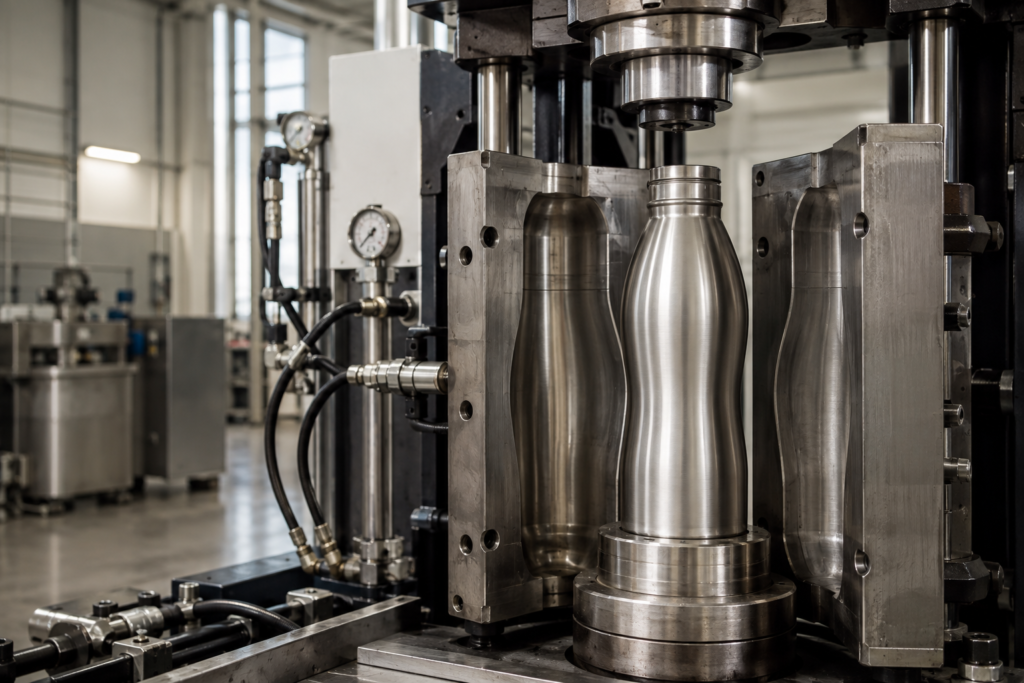
Hydroforming is a specialised metal‑shaping technique designed for hollow tubular or cup‑shaped workpieces. The entire forming process takes place inside a sealed precision mould. Liquid is injected into the hollow stainless‑steel shell, and controlled internal hydraulic pressure gradually expands the metal outward until it fully conforms to the mould’s internal geometry.
Unlike traditional mechanical forming that applies external force unevenly, hydroforming for tumblers and water bottles delivers uniform internal pressure across the entire inner wall of the bottle shell. This eliminates uneven stress distribution, avoids surface distortion, and produces ultra‑smooth, symmetrical 3D shapes with precise transition lines.
This process is ideal for manufacturing drinkware with the following features:
- Curved and contoured bottle bodies
- Ergonomic waist and tapered profiles
- Flared or extended shoulder structures
- Smooth rounded transition edges
- Ergonomic grip zones for comfortable holding
- Decorative 3D embossed contours
- Non‑standard cylindrical custom shapes
The final achievable shape depends on multiple controllable factors: initial shell dimensions, wall thickness, material ductility, mould precision, and customized pressure parameters.
The 6 Core Steps of Hydroforming Manufacturing
Step 1: Preparation of Stainless‑Steel Bottle Shells
Hydroforming is a secondary forming process. Raw workpieces are pre‑formed via deep drawing into basic hollow stainless‑steel shells before processing. Strict pre‑inspection is mandatory to eliminate defective blanks and ensure consistent forming results for your custom shaped insulated bottle.
Key inspection items include:
- Accurate height and diameter dimensions
- Uniform wall‑thickness distribution
- Clean, impurity‑free surface
- Zero cracks, dents, or deformation
- Smooth and intact edge conditions
- Perfect matching with custom moulds
Precise initial shell control is critical. Inconsistent size or thickness will cause uneven pressure distribution during expansion, leading to local over‑thinning, asymmetric profiles, or structural defects in finished products.
Step 2: Mould Loading and Precise Positioning
Qualified pre‑formed shells are manually or mechanically loaded into high‑precision sealed moulds. Accurate centring and positioning are essential for symmetric forming. Any offset during clamping will result in uneven expansion, inconsistent wall thickness on both sides, and skewed final contours.
After precise positioning, the mould is fully closed and the shell opening is tightly sealed, creating a closed space for stable hydraulic pressurisation.
Step 3: Controlled Internal Hydraulic Pressurisation
The equipment injects liquid into the sealed shell and steadily increases internal pressure. As hydraulic pressure rises, the stainless‑steel shell expands outward gradually. For complex deep‑contour designs, auxiliary axial thrust is applied from one or both ends of the shell to feed additional material into the forming zone.
Precise coordination between pressure‑rise speed and axial material feeding is the key to defect‑free forming:
- Excessively fast pressurisation causes over‑stretching and shell cracking
- Insufficient material feeding leads to severe local wall thinning
- Inadequate pressure results in incomplete mould fitting and blurred contours
Step 4: Final 3D Profile Formation
Under stable pressure and feeding parameters, the shell continues expanding until it perfectly fits the mould’s inner surface. The mould fully defines the bottle’s final appearance, including body diameter, shoulder‑transition radian, waist position, and decorative 3D contours.
Critical process parameters strictly controlled during this stage:
- Internal hydraulic pressure value
- Pressure‑rising rate
- Axial feeding distance and speed
- Overall forming‑cycle speed
- Mould dimensional accuracy
- Initial shell wall thickness and material ductility
- Surface lubrication condition
Different bottle shapes require tailored parameter sets. Gentle curved profiles and deep tapered waists demand entirely different pressure and feeding configurations.
Step 5: Pressure Holding and Dimensional Calibration
Once the target profile is achieved, the system maintains stable internal pressure for a short period. This pressure‑holding stage allows the metal material to fully fit the mould, eliminate elastic rebound, and standardise product dimensions.
This calibration process effectively improves:
- Overall profile accuracy
- Batch‑to‑batch dimensional consistency
- Sharpness of contour‑transition lines
- Metal‑rebound deformation issues
- Mass‑production stability and yield rate
After calibration, pressure is released and the mould is opened for demoulding.
Step 6: Demoulding, Trimming and Post‑Processing
Formed bottle shells are removed from the mould and subjected to comprehensive first inspection. Excess edge materials and uneven burrs are trimmed and polished. Individual products with minor deformation undergo secondary shaping to meet precision standards.
Hydroformed shells with qualified dimensional accuracy can smoothly proceed to subsequent processes: bottom welding, vacuum insulation, surface polishing, coating treatment, and accessory assembly.
Common Hydroforming Defects & Causes
Strict process control is required to avoid typical manufacturing defects when producing hydroformed drinkware:
- Local Wall Thinning: Over‑expansion in curved or tapered areas reduces structural strength and increases cracking risks.
- Shell Cracking: Excessive hydraulic pressure beyond material ductility limit, occurring mainly at high‑curvature positions.
- Surface Wrinkling: Improper material feeding, mould gaps, or unstable pressure cause redundant material accumulation and folds.
- Incomplete Forming: Insufficient pressure leads to poor mould fitting and incomplete or blurry 3D contours.
- Surface Scratches & Indentations: Dirty mould surfaces, poor lubrication, or foreign impurities cause visible surface defects.
- Batch Inconsistency: Fluctuations in initial shell size, positioning accuracy, or pressure parameters lead to uneven product profiles across batches.
Post‑Hydroforming Quality Inspection Standards
All hydroformed shells must pass full inspection before entering subsequent production procedures to ensure zero defective products flow into mass processing. Core inspection items cover dimensions, appearance, structure, and assembly compatibility:
- Precise height and diameter verification
- Overall profile symmetry and smoothness
- Accurate size of shoulders, waists and decorative contours
- Uniform wall‑thickness distribution
- Surface flaw detection (scratches, dents, wrinkles)
- Crack and local‑thinning inspection
- Complete edge and mouth condition
- Matching tolerance with lids, bases and other accessories
- Consistency with technical drawings and approved samples
Hydroforming vs. Deep Drawing: Key Differences
Deep drawing vs hydroforming for drinkware are two complementary, sequential processes in stainless‑steel drinkware manufacturing, with distinct functional positioning:
Deep Drawing: The primary forming process that flattens stainless‑steel sheets into basic straight cylindrical hollow shells, completing the initial structural shaping of the bottle body.
Hydroforming: The secondary precision‑forming process that remodels the pre‑formed straight shell into complex ergonomic and decorative 3D profiles.
Not all drinkware requires hydroforming. Standard straight‑cylindrical bottles can skip this process and directly enter trimming and welding. Hydroforming is exclusively applied to products with curved surfaces, flared shoulders, tapered waists, and other complex custom shapes, delivering unique aesthetic and ergonomic advantages.
Key Design Considerations for Hydroformed Drinkware
Custom bottle‑shape design for hydroforming must balance aesthetic innovation and production feasibility. Professional design evaluation focuses on:
- Maximum allowable expansion ratio of the metal shell
- Minimum safe wall thickness to avoid structural damage
- Smooth curve‑transition radius (prevent sharp‑angle cracking)
- Depth of waist taper and decorative 3D contours
- Matching design of initial pre‑formed shell size
- Reasonable layout of welding and trimming areas
- Compatibility with subsequent polishing, coating and printing processes
- Dimensional tolerance requirements for accessory assembly
Pre‑production sampling testing is essential to verify forming stability, predict potential risks such as thinning, cracking and wrinkling, and optimise designs for mass‑production feasibility.
Conclusion: Precise Hydroforming for Premium Custom Drinkware
Hydroforming technology empowers the creation of high‑end stainless‑steel drinkware with diverse, smooth, and ergonomic complex shapes. Stable and reliable forming quality relies on the precise coordination of raw‑material performance, initial shell precision, mould accuracy, hydraulic‑pressure control, and strict quality‑inspection systems.
Custom Drinkware Manufacturing Service
Hongrong Industry & Vflasche provides one‑stop custom drinkware solutions, covering product design, prototype sampling, OEM/ODM mass production, surface finishing, quality control, packaging and global shipping support.
If you have custom bottle‑shape demands, please share your design sketches, reference images, target capacity, dimensional requirements, and order quantity. We offer professional manufacturability evaluation and tailored production solutions for your brand.