
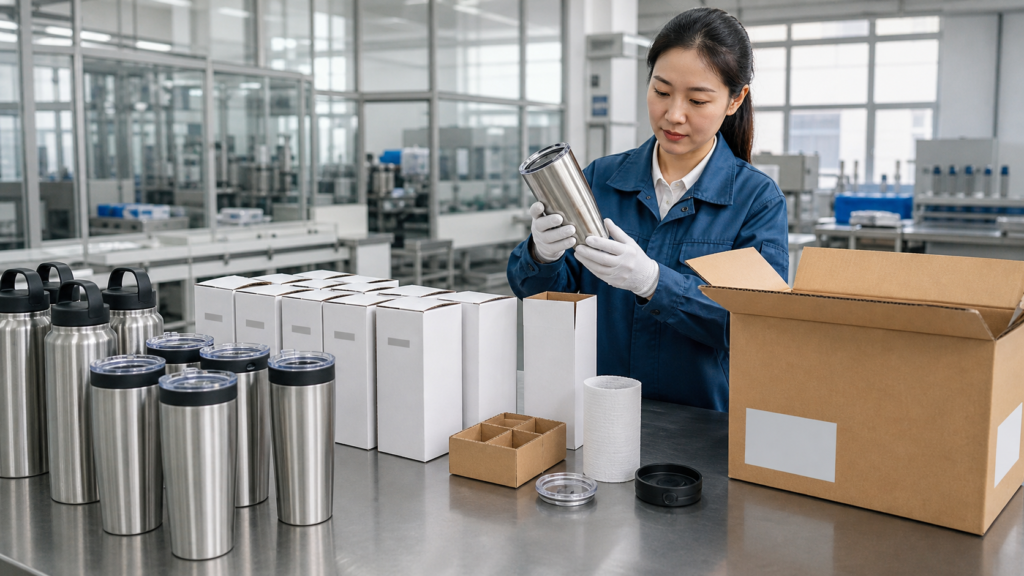
Quality is one of the most important factors in custom drinkware manufacturing. A product must meet the agreed requirements for materials, construction, sealing performance, surface finish, branding, packaging, and everyday use.
Yongkang Hongrong Industry & Trade Co., Ltd., through its Vflasche brand, follows a structured quality-control process for custom water bottles, insulated bottles, tumblers, mugs, and other drinkware products.
Inspection requirements vary depending on the product type, order quantity, target market, and customer specifications. The following sections explain how we manage quality throughout a typical custom drinkware project.
Quality Control Begins Before Mass Production
Quality control begins as soon as the customer’s product requirements are confirmed.
Before production, Hongrong and Vflasche review the following key specifications:
- Product model and capacity
- Material requirements
- Color and surface finish
- Logo size, position, and decoration method
- Lids, straws, handles, and other accessories
- Packaging and labeling
- Carton quantities and shipping marks
- Customer-specific inspection standards
These confirmed specifications provide the basis for sampling, production, and inspection.
Step 1: Incoming Material Inspection
The first stage focuses on inspecting the raw materials and components required for production.
Depending on the product, these may include stainless-steel parts, plastic components, lids, silicone seals, straws, handles, coating materials, and packaging supplies.
The main purpose is to confirm that the materials and components match the approved product requirements and are suitable for the next stage of production.
Step 2: Pre-Production Sample Approval
Before mass production, we prepare a pre-production sample for customer review and approval.
The sample is used to confirm:
- Product dimensions and capacity
- Color and surface finish
- Logo size and position
- Printing and decoration quality
- Accessories and assembly
- Packaging presentation
Once the customer approves the sample, it and the corresponding production specifications become important quality references for the order.
Step 3: First-Article Inspection
At the beginning of mass production, the first completed units are inspected before full-scale production continues.
This inspection confirms whether the production settings, materials, colors, logo application, assembly, and overall appearance meet the approved standards.
If any issue is identified, adjustments can be made before larger quantities are produced, helping prevent repeated defects.
Step 4: In-Process Inspection
Quality inspection continues throughout production instead of being carried out only after all products are completed.
In-process inspections may cover:
- Product dimensions and construction
- Surface finish and color consistency
- Logo position and printing quality
- Lid and accessory assembly
- Scratches, dents, stains, and other visible defects
- Workmanship and overall appearance
Identifying issues during production allows corrective action to be taken at an earlier stage.
Step 5: Functional and Performance Testing
Drinkware products must perform correctly under normal everyday use.
Depending on the product and customer requirements, testing may include:
- Leak-resistance testing
- Lid opening and closing checks
- Seal and silicone-ring inspection
- Component fitting and assembly checks
- Insulation-performance testing
- Capacity and weight verification
- Handle, straw, and accessory checks
The exact testing methods and inspection requirements are determined by the product design and confirmed order specifications.
Step 6: Logo and Appearance Inspection
Inspectors verify that the logo, colors, and surface finish are consistent with the approved sample and artwork.
The inspection covers logo size, position, clarity, color consistency, and overall presentation.
Products are also checked for visible defects such as scratches, dents, stains, uneven coating, printing imperfections, and poor assembly.
Step 7: Packaging Inspection
Before shipment, the packaging is checked against the approved requirements.
The inspection may include:
- Individual bags or protective wrapping
- White boxes or custom color boxes
- Labels and barcodes
- Instruction cards
- Product quantities
- Carton markings
- Protective export packaging
For Amazon, Shopify, retail, and wholesale customers, labels and packaging are also checked against the requirements of their respective sales channels.
Step 8: Final Inspection Before Shipment
After production and packaging are completed, a final inspection is performed before the goods are released for shipment.
The final inspection may cover product appearance, quantities, accessories, branding, inner and outer packaging, carton information, and selected functional requirements.
If an issue is identified, the affected products are reviewed and handled before the shipment is approved.
Consistent Quality Requires Clear Standards
A reliable quality-control system depends on clear technical specifications, approved samples, production monitoring, and effective communication between the customer and the manufacturer.
Hongrong and Vflasche confirm key requirements before production and use them as references throughout manufacturing and inspection.
Even a thorough inspection process cannot replace clear communication at the beginning of a project. Providing complete product, branding, packaging, and market requirements helps reduce misunderstandings and supports more consistent results.
Start Your Custom Drinkware Project
Whether you need custom water bottles, insulated bottles, tumblers, mugs, or other drinkware products, Hongrong and Vflasche can support project evaluation, sampling, OEM/ODM manufacturing, quality control, packaging, and shipment coordination.
Contact us to discuss your product specifications, customization requirements, MOQ, sampling plan, quality standards, packaging, and delivery schedule.